What Does “Top of the Morning” Really Mean?
Ever heard someone say, “Top of the morning to you” and wondered if you time-traveled back a few centuries? You’re not alone.
While it sounds like something straight out of an old movie—or maybe a touristy Irish pub—it still pops up in conversation, literature, and even emails. But what does it actually mean? And more importantly, how should you reply to it without sounding awkward?
This guide breaks it down. We’ll cover the phrase’s roots, when to use it, how to respond politely, and some modern synonyms or alternatives that sound less like a leprechaun might’ve said them.
Let’s get into it.
What Does “Top of the Morning” Actually Mean?
“Top of the morning” is a warm and cheerful way to greet someone. It basically means “I hope you have the best part of the morning” or “Wishing you a good start to your day.”
Think of it as the old-school equivalent of saying “Good morning” with a bit of extra flair or formality.
But here’s the catch: it’s rarely used in everyday modern speech—unless someone’s going for an old-fashioned or playful tone. So, while it sounds polite, it might also feel a bit out of place in regular conversation.
The Origin and History of the Phrase
The phrase is often tied to Irish culture, although actual Irish people don’t use it nearly as much as movies make it seem.
So where did it come from?
The phrase first showed up in 19th-century English and Irish literature. Back then, it was a way to wish someone a fine start to their day. The “top” referred to the best part—like the cream on top of milk.
Think about how we say “top-notch” or “top-tier.” It’s the same idea.
Oddly enough, despite its strong association with Ireland, the phrase was rarely used in traditional Irish speech. It’s more of a stereotype, popularized by media and tourism.
Over time, it became a kind of cultural shorthand—more used for effect than for real communication.
How & When to Use “Top of the Morning”
Let’s be honest—using “top of the morning” today takes guts. It’s old-fashioned, a bit dramatic, and definitely not common. But it still has a place—if used the right way.
When It Might Work:
- In a playful or theatrical setting
- During St. Patrick’s Day celebrations
- If you’re writing a period piece or novel
- When you’re going for a charming, over-the-top greeting
When It Might Not:
- In a formal work email (unless you’re being cheeky)
- In everyday small talk with people who might think you’re joking
- When you want to sound modern and casual
So yes, you can use it—but context is everything. If you’re unsure, it’s better to stick to safer greetings like “Good morning” or “Hope you’re having a great start to your day.”
Explore This Topic: Material Girl Meaning: Definition, Origin & Slang Use
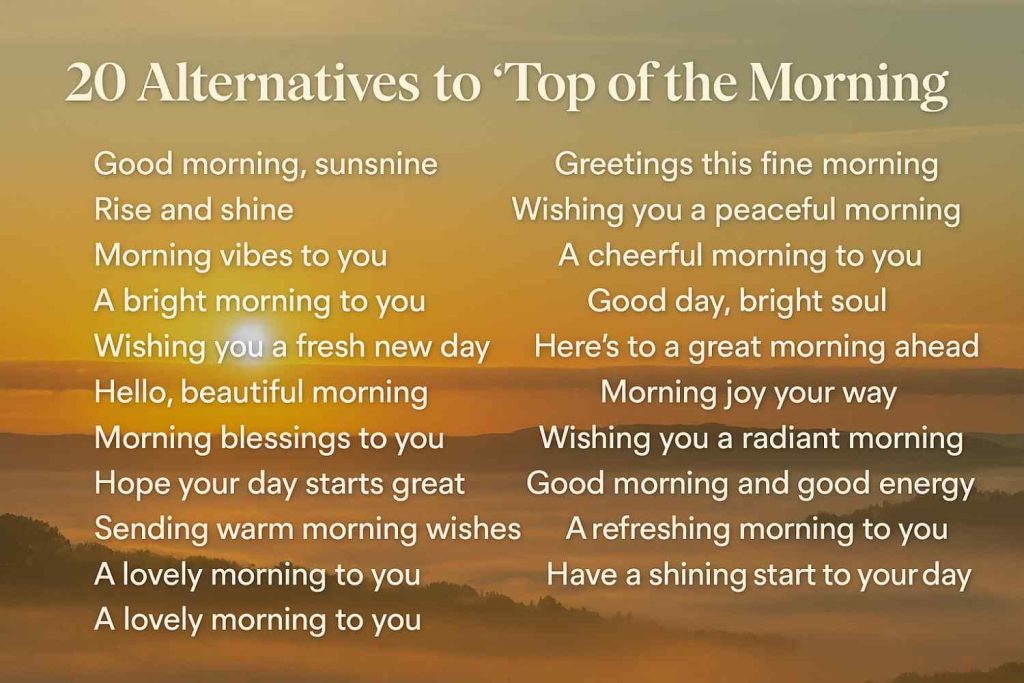
20 Alternatives to “Top of the Morning”
Want to keep things fresh but skip the drama? Here are 20 alternatives that sound a bit more modern but still carry the same polite or cheerful tone.
Alternative Ways
1. Good morning
Meaning: A standard greeting used in the early part of the day.
Explanation: Simple, friendly, and always appropriate.
Example: “Good morning! How’d you sleep?”
Best Use: Anytime before noon—in emails, texts, or face-to-face.
2. Morning!
Meaning: An informal version of “Good morning.”
Explanation: Short and casual.
Example: “Morning! Got your coffee yet?”
Best Use: Among friends, coworkers, or in casual chats.
3. Hope your day’s off to a great start
Meaning: A well-wishing greeting
Explanation: Shows you care about how their day begins
Example: “Hey, hope your day’s off to a great start!”
Best Use: Emails, messages, or friendly conversations.
4. Wishing you a good morning
Meaning: A formal well-wish
Explanation: Polite and slightly more traditional
Example: “Just dropping in to wish you a good morning!”
Best Use: Professional emails or polite messages.
5. Happy morning
Meaning: Cheerful take on “Good morning”
Explanation: Brightens up the tone instantly
Example: “Happy morning to you!”
Best Use: Casual settings or uplifting messages.
6. Rise and shine!
Meaning: Wake up and get going
Explanation: Motivational and upbeat
Example: “Rise and shine! Big day ahead.”
Best Use: Informal, especially with close friends or family.
7. It’s a beautiful morning
Meaning: Comment on the weather as a greeting
Explanation: Adds a bit of personality
Example: “It’s a beautiful morning, isn’t it?”
Best Use: Outdoor chats, early events, or weather talk.
8. How’s your morning going?
Meaning: A casual check-in
Explanation: Shows interest in their day
Example: “Hey! How’s your morning going so far?”
Best Use: In person or in messages, both casual and semi-formal.
9. Top day ahead!
Meaning: Wish someone a great day
Explanation: Short, peppy twist
Example: “Morning! Top day ahead!”
Best Use: Casual work chats or friendly banter.
10. Hey, sunshine!
Meaning: A warm, affectionate greeting
Explanation: Feels personal and caring
Example: “Hey, sunshine! How are you today?”
Best Use: Personal conversations or upbeat texts.
11. What a lovely morning!
Meaning: Comment and greet
Explanation: Combines weather and greeting
Example: “What a lovely morning to see you!”
Best Use: Outdoor settings or morning walks.
12. A fresh start to the day
Meaning: Acknowledge new beginnings
Explanation: Encouraging tone
Example: “Let’s make the most of this fresh start to the day.”
Best Use: Motivational talks or group chats.
13. Bright and early, huh?
Meaning: Light, humorous greeting
Explanation: A bit cheeky, very casual
Example: “You’re up bright and early, huh?”
Best Use: Between friends or early workmates.
14. Good to see you this morning
Meaning: Polite, face-to-face greeting
Explanation: Acknowledges their presence
Example: “Good to see you this morning, Sarah.”
Best Use: Meetings, events, or casual greetings.
15. Let’s own the day
Meaning: Motivational
Explanation: High-energy greeting with purpose
Example: “Good morning! Let’s own the day!”
Best Use: Workplace teams or morning check-ins.
16. Hope your coffee’s strong
Meaning: Funny and relatable
Explanation: Perfect for sleepy mornings
Example: “Hope your coffee’s strong this morning!”
Best Use: Casual, coffee-loving friends or colleagues.
17. Ready to take on the morning?
Meaning: Encouraging
Explanation: Motivates and checks in
Example: “Hey! Ready to take on the morning?”
Best Use: Slack messages or morning team calls.
18. Morning vibes only
Meaning: Trendy and casual
Explanation: Feels light and positive
Example: “Morning vibes only. Let’s roll!”
Best Use: Social media, casual chats.
19. Let the morning treat you well
Meaning: Kind-hearted well-wish
Explanation: A bit poetic, yet friendly
Example: “Hope the morning treats you well!”
Best Use: Thoughtful texts or messages.
20. Hello, early bird
Meaning: Greet someone who’s up early
Explanation: Playful tone
Example: “Hello, early bird! What’s up?”
Best Use: Informal settings or inside jokes.
Simple and Polite Responses to “Top of the Morning”
Let’s say someone throws “Top of the morning” your way. Don’t panic. A thoughtful reply can keep the tone friendly and smooth.
Here are a few ways you can respond:
- “And the rest of the day to yourself!” (This is the traditional Irish response.)
- “Good morning!” (Easy and safe.)
- “Thanks! Same to you.”
- “Appreciate it. Hope you have a great one too.”
- “Right back at you!”
The key is to match the tone. If they’re being playful, you can be too. If it feels formal, keep your reply polite and simple.
Conclusion
“Top of the morning” is one of those quirky phrases that still turns heads. It’s got history, charm, and a certain flair—just not much modern usage. Whether you’re brushing up on old greetings or looking for synonyms that feel fresh, the goal is the same: be friendly, be clear, and read the room.

A former editor and grammar geek, David Langford has spent years refining the art of clear communication. He combines his journalism background with a knack for teaching, offering straightforward tips to master tricky grammar rules. When he’s not proofreading, he’s probably debating Oxford commas.