What Does Goomar Mean? Understanding the Term and Its Origins
Let’s face it—some words just stick in your head. Goomar is one of them. You might’ve heard it thrown around in movies like The Sopranos or maybe whispered at family gatherings with raised eyebrows and a knowing smirk. But what does it actually mean? And why does it sound both funny and serious at the same time?
This word is packed with cultural weight, tied to family, tradition, secrecy, and sometimes scandal. It’s one of those terms that lives on the edge of humor and taboo. So if you’re curious—maybe even a little suspicious—it’s time to clear things up.
Explore Further : What Does “Negative, Ghost Rider” Mean? A Clear Guide to the Slang Term
The Definition of Goomar
Straight to the point: goomar (also spelled goomah) is a slang term used in Italian-American communities. It refers to a man’s mistress—specifically one he’s involved with outside his marriage.
The word isn’t exactly polite. It’s the kind of thing people say in hushed tones, especially around grandma. But it’s also not always meant with venom. Depending on the context, it can carry a smirk, a sigh, or a full-on eye-roll. Think of it as a cultural code word—used to talk about things people don’t always want to say outright.
The Origin and History of the Word Goomar
Let’s trace it back.
The root of goomar comes from the Italian word comare. Traditionally, comare meant “godmother” or a close female friend of the family. In southern Italian dialects—especially in regions like Calabria or Naples—it morphed into something a bit more colloquial.
When Italian immigrants came to America in the late 19th and early 20th centuries, their language came with them. But it changed—bent by English influence, new slang, and the rhythms of street life. That’s how comare became goomar in certain communities.
Over time, especially in the mid-20th century, goomar started to shift again. No longer just a family friend or godparent, the word picked up a new meaning: the “other woman.”
Goomar in Italian-American Culture
Here’s where things get more layered.
In Italian-American culture, family is sacred. The ties run deep—Sunday dinners, nicknames, generations packed into one house. But like every culture, it has its contradictions. While loyalty and marriage are core values, there’s also a long-standing, often unspoken reality: some men kept a goomar on the side.
This was especially common in stories coming out of mid-century immigrant neighborhoods. And of course, it was popularized in Mafia films and shows. Think The Godfather, Goodfellas, and The Sopranos. In those worlds, having a goomar wasn’t just normal—it was expected. Wives knew. Mistresses knew. Everyone looked the other way—until they didn’t.
That said, not every Italian-American family uses the term, and it’s not some kind of cultural norm across the board. But in certain circles—especially older generations—the word carried weight. It’s also worth noting the word often carried a mix of humor and judgment. Someone might joke, “He’s out with his goomar again,” but there’d be a sting underneath.
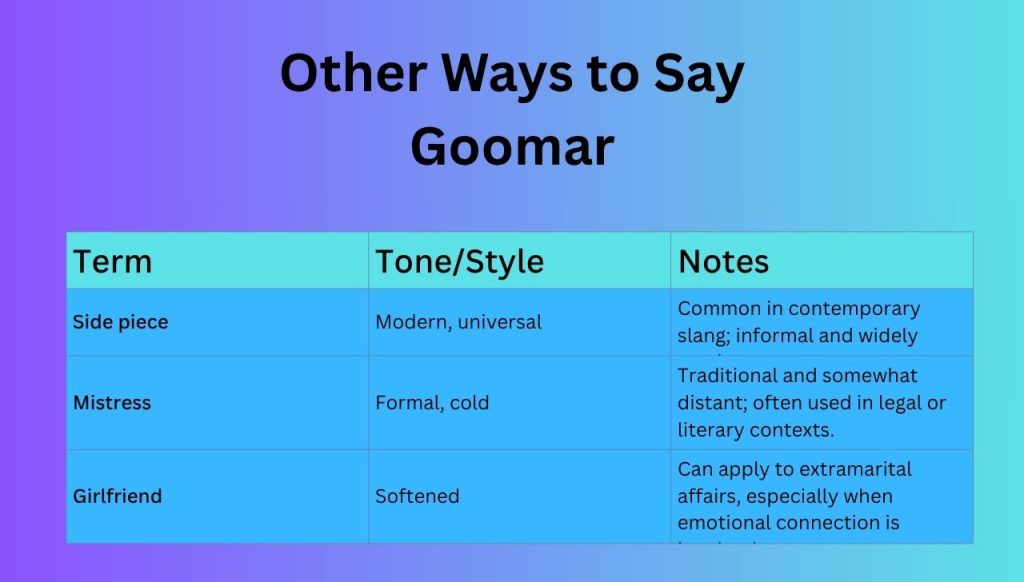
Other Ways to Say Goomar
Language doesn’t stand still. Over the years, other slang terms cropped up to mean the same thing.
| Term | Tone/Style | Notes |
|---|---|---|
| Side piece | Modern, universal | Common in contemporary slang; informal and widely used. |
| Mistress | Formal, cold | Traditional and somewhat distant; often used in legal or literary contexts. |
| Girlfriend | Softened | Can apply to extramarital affairs, especially when emotional connection is involved. |
| The other woman | Dramatic, scandalous | Carries strong emotional and cultural connotations; often used in gossip or drama. |
| Piece on the side | Old-school, crude | Slightly vulgar; implies a purely physical or secretive relationship. |
Each one hits a little differently. Goomar is unique because it’s wrapped in cultural flavor. It’s not just about cheating—it’s about tradition, secrecy, and community gossip.
Related Terms: Goomah, Gumad, and More
If goomar sounds a little unfamiliar, maybe you’ve heard one of its cousins.
- Goomah – Same meaning, just a different spelling. This is probably the most common version used in pop culture.
- Gumad – A variation that pops up in certain accents or neighborhoods, especially in New York and New Jersey.
- Comare – The original term in Italian, still used in parts of Italy in its traditional meaning.
Spelling varies depending on region, family, and even how someone first heard the word. That’s how oral traditions work—they change as they’re passed along. No one handed out dictionaries in Little Italy.
And let’s be real—some of these spellings probably came from how people heard the word, not how it was written. That’s why it’s not unusual to see “goomar” and “goomah” used interchangeably.
Explore Further : What Does “Oh My Lanta” Mean? A Clear Explanation of the Phrase
Conclusion
So, what does goomar mean? On the surface, it’s simple: a mistress. But behind that short definition lies a rich blend of culture, history, and neighborhood lore. It’s a word you don’t just read—you feel it. You hear it in old family stories or gritty crime shows. It rolls off the tongue like a secret half-told, wrapped in pasta sauce and whispered behind closed doors.
And whether you find it funny, offensive, or just fascinating, one thing’s clear—goomar is more than just slang. It’s a time capsule from another era, still echoing in some corners of the world. So next time someone drops that word mid-conversation, you’ll know exactly what they’re talking about—and maybe you’ll raise an eyebrow, just for effect.

A former editor and grammar geek, David Langford has spent years refining the art of clear communication. He combines his journalism background with a knack for teaching, offering straightforward tips to master tricky grammar rules. When he’s not proofreading, he’s probably debating Oxford commas.